
AdBlue Explained: Why Your Diesel Needs It
If you drive a modern diesel, you'll have an AdBlue tank whether you realise it or not, and ignoring it can leave you stranded. The good news is that AdBlue is simple to understand and cheap to top up once you know how. This guide explains what AdBlue is, why your diesel needs it, what the warning light means, and whether you can keep driving without it.
What Is AdBlue
So, what is AdBlue? It's a clear, non-toxic fluid made from 32.5% urea and deionised water, used by modern diesel vehicles to reduce harmful exhaust emissions. Despite the name, it isn't a fuel additive and you never mix it with diesel: it lives in its own separate tank, usually with a filler cap near the diesel one.
AdBlue works as part of a system called Selective Catalytic Reduction, or SCR. Small amounts are injected into the hot exhaust, where they react with nitrogen oxides (NOx), the harmful gases diesels produce, and turn them into harmless nitrogen and water vapour. Virtually every diesel car and van built from around September 2015, when tighter Euro 6 emissions rules came in, uses it. If you're not sure whether yours does, your handbook will confirm it.
Why Your Diesel Needs It
Diesel engines are efficient, but they produce nitrogen oxides that are harmful to both health and the environment. AdBlue is how modern diesels meet strict emissions limits, neutralising most of those gases before they leave the exhaust.
There's a practical reason it matters to you, too. A working AdBlue system is part of what allows a diesel to pass the MOT emissions test, and the car is designed so it simply won't run indefinitely without it (more on that shortly). In other words, AdBlue isn't optional: it's built into how the car is allowed to operate on the road.
The AdBlue Warning Light and What It Means
Your car gives you plenty of notice before AdBlue becomes a problem, usually in three stages.
- First, an amber warning light appears, often with a message like "Refill AdBlue soon," typically when you've around 1,000 to 1,500 miles of AdBlue left. There's no need to panic, but do plan to top up.
- Next, a countdown begins, showing how many miles remain before the car won't start. Top up at this point rather than leaving it to the last few miles.
- Finally, a red warning and limp mode, where power is reduced, followed by the car refusing to restart once you switch off.
If the AdBlue warning light stays on even after you've topped up, that usually points to a sensor or SCR fault rather than a low level, and it's worth getting diagnosed.
Can You Drive Without AdBlue
This is the question that catches people out, so let's be clear: can you drive without AdBlue? Only until it runs out. While there's still fluid in the tank, the car drives normally. As the level gets critical, it enters limp mode with reduced power, and once the tank is empty and you turn the engine off, it will not restart until you top it up.
This isn't a fault or a mechanical breakdown; it's deliberately built in to enforce emissions law. The car's computer won't let a diesel keep running while pumping out untreated NOx. The takeaway is simple: don't ignore the warnings, because being stranded with a car that won't start is entirely avoidable with a cheap top-up.
How to Top Up AdBlue and What It Costs
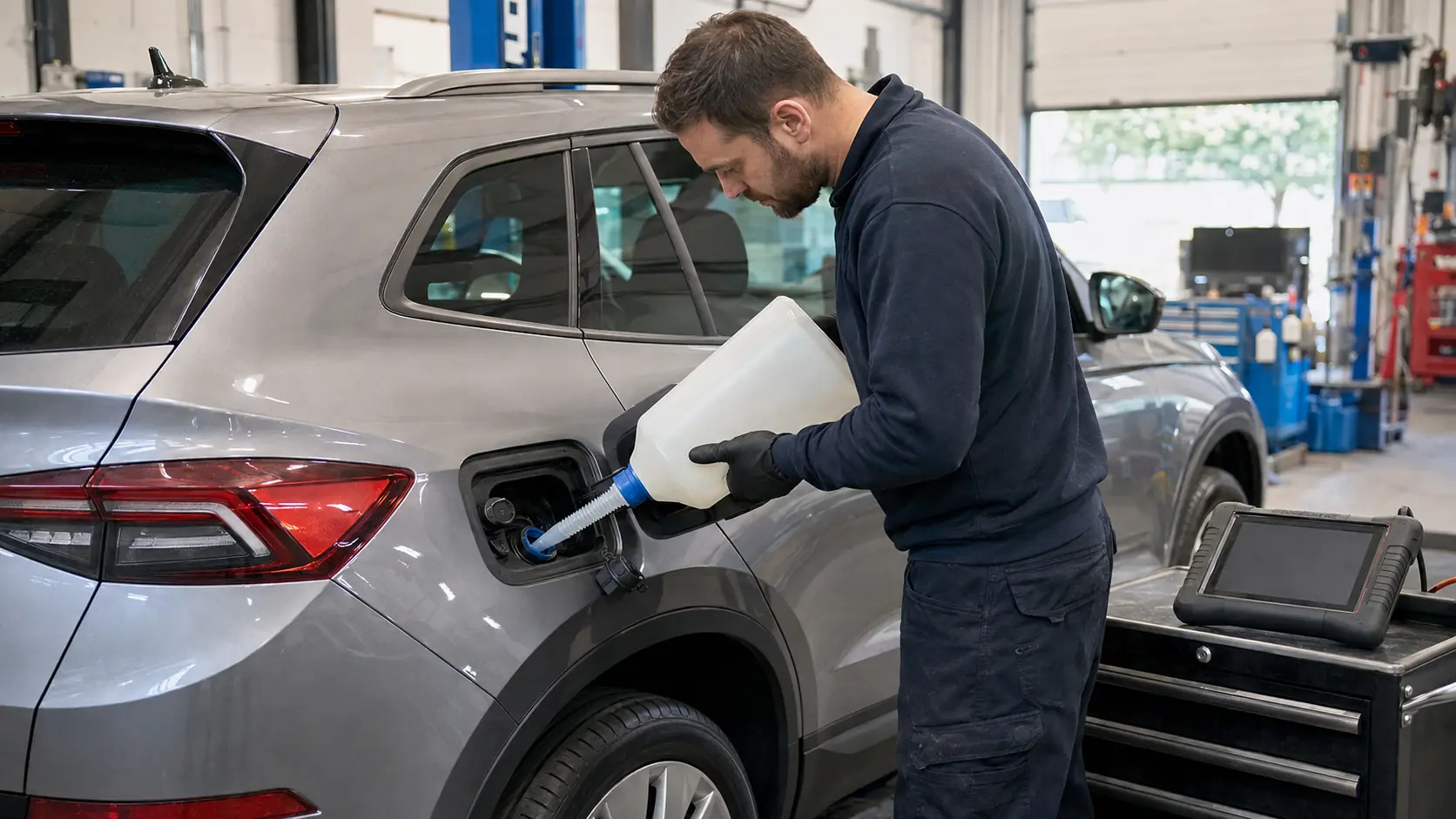
Topping up is usually a quick, cheap DIY job, and you won't be doing it often. Most diesels use roughly 1 to 2 litres of AdBlue every 600 miles, so a full tank lasts thousands of miles, and many drivers only need to top up once or twice a year. You can buy AdBlue in 10-litre containers with a no-spill spout from most fuel stations, supermarkets, Halfords and motor factors, so finding AdBlue near me is rarely a problem. Some forecourts even have AdBlue pumps that dispense it by the litre, which is the cheapest way to buy it.
As for the adblue top up cost, a 10-litre container is typically around £8 to £15, and a single top-up will usually last thousands of miles. If you'd rather a garage do it, expect to pay a little more for the fluid plus a small labour charge, often around £25 to £40. Just take care with two things: pour slowly, as AdBlue can stain paintwork, and never, ever put AdBlue in your diesel tank or diesel in your AdBlue tank. That mistake can cause serious damage costing thousands, so if it happens, don't start the engine and call for recovery.
AdBlue Help in Doncaster
For most drivers, topping up AdBlue is a simple job you can do yourself. But if your warning light won't clear after a top-up, if the car has gone into limp mode, or if you're just not comfortable doing it, a garage can sort it quickly and check the SCR system at the same time.
Simply Motoring is a DVSA-approved garage in Doncaster offering AdBlue top-ups, diesel diagnostics and all our servicing and repairs in-house, with honest pricing and no pressure. If a warning light points to a sensor or dosing fault rather than a low level, we can diagnose and fix it properly, so you're not left guessing.
Conclusion
AdBlue is nothing to worry about once you understand it: a simple fluid that keeps your diesel's emissions in check, topped up occasionally from a cheap container. Just don't ignore the warning light, because while you can drive on it for a while, a diesel won't restart once the tank runs dry. Keep an eye on the light, top up in good time, and you'll never be caught out.
For drivers in Doncaster, Simply Motoring offers DVSA-approved testing, honest pricing, expert technicians and any repairs carried out on site, with no jargon and no pressure. Book in with Simply Motoring today, or get in touch if you have any questions about AdBlue or your diesel.