
Your tyres are the only thing connecting your car to the road, so it's no surprise the law takes them seriously. Falling foul of the tyre tread depth law in the UK can mean a heavy fine, penalty points and a failed MOT, yet it's easy to avoid with a 30-second check. This guide explains exactly what the law requires, how to check your tyres, and when to replace them.
What Is the Tyre Tread Depth Law in the UK
The tyre tread depth law in the UK is straightforward: for cars and vans up to 3.5 tonnes, the legal minimum tread depth is 1.6mm. But there's a detail many drivers miss. That 1.6mm must be present across the central three-quarters of the tyre's width, and all the way around its circumference.
In practice, that means one worn patch is enough to make a tyre illegal. If one groove measures a healthy 2mm but another reads 1.4mm, the tyre is over the line. The legal tyre tread depth comes from the Road Vehicles (Construction and Use) Regulations, and it applies to every tyre on the car. For reference, a brand-new tyre has around 8mm of tread, so 1.6mm is very worn indeed. Motorcycles and larger vehicles have their own separate limits.
The Fine for Illegal Tyres
The penalties are severe, and this is where drivers often get a nasty shock. The tyre tread depth fine is up to £2,500 and three penalty points, and crucially it applies per tyre, not per car. So four illegal tyres could, in theory, mean a £10,000 fine and 12 penalty points, which is enough for an automatic driving ban.
It doesn't stop at the fine, either. Any tyre below 1.6mm is an automatic MOT failure, the police or DVSA can issue a prohibition notice stopping you driving the car until it's fixed, and illegal tyres can invalidate your insurance, leaving you exposed if you're involved in a collision. Put simply, worn tyres are one of the most expensive things to ignore.
Why 1.6mm Isn't Enough
Here's the important part: 1.6mm is the legal floor, not a safety target. Independent testing consistently shows that wet-weather braking distances increase sharply once tread drops below 3mm, long before you reach the legal limit.
That's why road-safety bodies like the RAC, TyreSafe and RoSPA recommend replacing your tyres at around 3mm rather than waiting for 1.6mm. On a wet road, that extra tread can be the difference between stopping in time and not. If you run winter or all-season tyres, the advice is to replace even earlier, at around 4mm, since they lose their cold-weather grip below that. Treating 3mm as your personal limit is one of the cheapest safety upgrades you can make.
How to Check Your Tyre Tread
Knowing how to check tyre tread takes seconds and could save you a fortune. There are three simple methods, in ascending order of accuracy:
- The 20p test. Slot a 20p coin into the main tread grooves. If you can see the outer band of the coin, your tread may be getting low and you should have it measured properly. It's a handy quick check, not an exact measurement.
- The tread wear indicators. Every tyre has small raised bars set into the grooves at 1.6mm. When the surrounding tread wears down level with these bars, the tyre is at the legal limit and needs replacing.
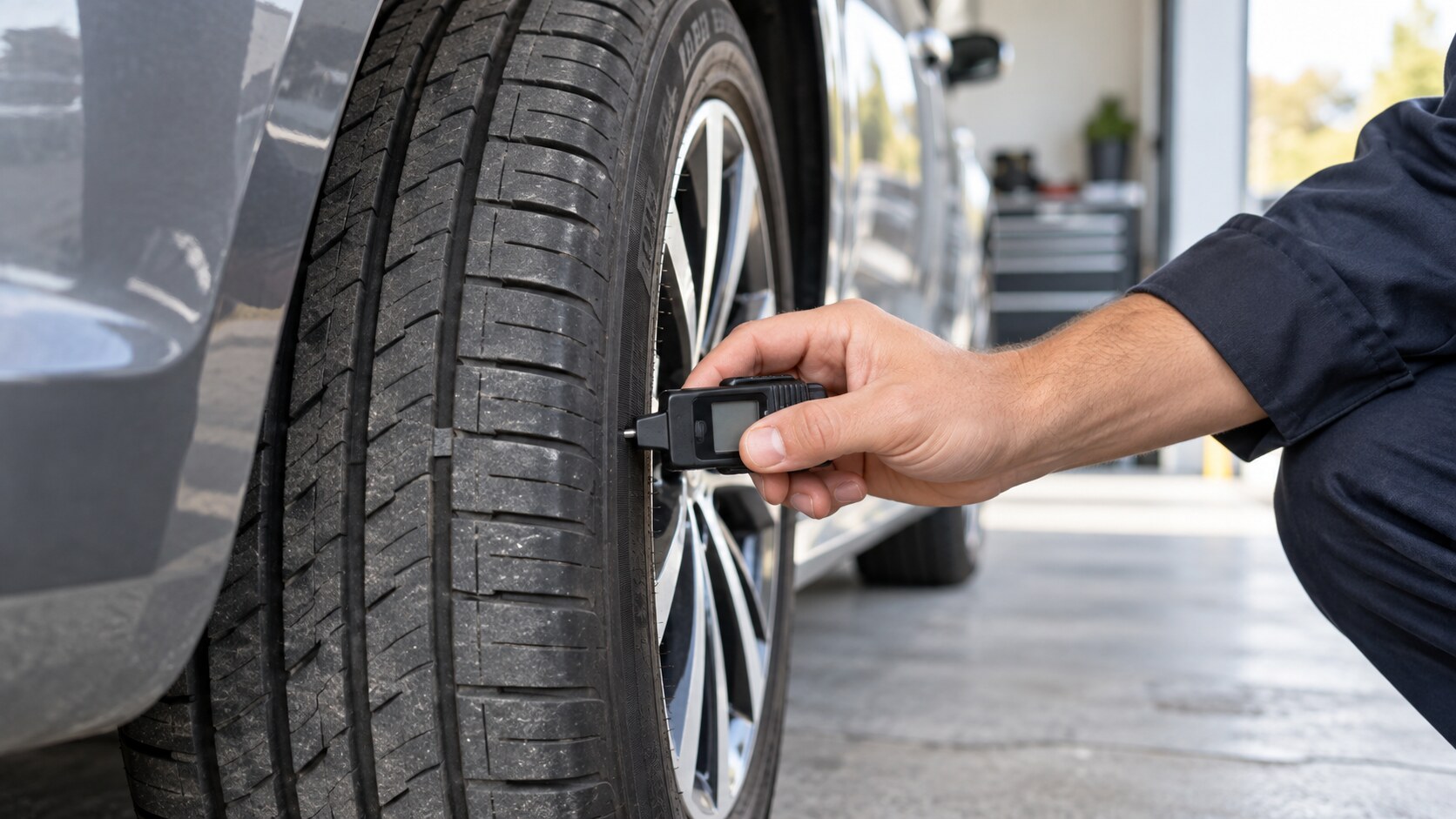
- A tread depth gauge. The most accurate method, and a gauge costs only a few pounds. Measure in several places across each tyre and around it, since wear is rarely even.
Whichever you use, check all four tyres, and don't forget the spare. It's worth doing a quick check at least once a month, and before any long journey, since tread can wear faster than you'd expect and a slow puncture or fresh kerb damage can appear between checks.
When to Replace Your Tyres
Tread depth is the headline, but it isn't the only reason to replace a tyre. Change your tyres when:
- The tread is at or approaching 3mm (or 4mm for winter tyres), following the safety advice rather than the bare legal minimum.
- You can see or feel any bulges, cuts or cracks in the sidewall. A bulge is dangerous and an automatic MOT failure regardless of tread.
- The tyre is wearing unevenly, which often points to an alignment or suspension issue worth checking.
- The tyres are getting old. Rubber degrades with age, so it's worth having tyres over five years old checked, and most are replaced by around ten years regardless of tread.
If in doubt, a garage can measure and inspect your tyres in a couple of minutes.
Tyre Checks in Doncaster
Checking your own tread is quick and worth doing regularly, but if you're not sure, or a tyre looks worn or damaged, it's best to get it looked at properly. A garage can measure the tread accurately, spot damage you might miss, and fit new tyres if needed.
Simply Motoring is a DVSA-approved garage in Doncaster offering tyre checks, tyre fitting and all our servicing and repairs in-house, with honest pricing and no pressure. We'll tell you honestly whether your tyres are legal and safe, or genuinely need replacing, so you're never sold tyres you don't need.
Conclusion
The tyre tread depth law in the UK is clear: at least 1.6mm across the central three-quarters of every tyre, or you risk up to £2,500 and three points per tyre, plus a failed MOT and invalid insurance. But safe is better than just legal, so check your tread regularly with the 20p test and aim to replace at 3mm. It's a small habit that protects your licence, your wallet and your safety.
For drivers in Doncaster, Simply Motoring offers DVSA-approved testing, honest pricing, expert technicians and any repairs carried out on site, with no jargon and no pressure. Book a tyre check with Simply Motoring today, or get in touch if you have any questions first.